Monday, February 25, 2013

Discretionary Spending has Doubled since 2000, so Why the Panic Over Sequestration?

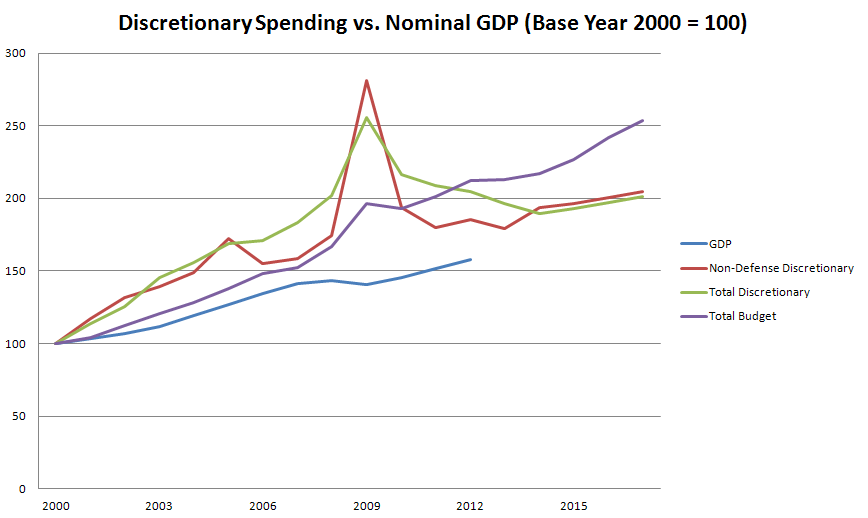
Check out this graph that I came up with using the White House's historical budget tables and nominal GDP data from FRED:


As you can see, government spending has dwarfed the growth in the economy since 2000 with even non-Defense discretionary spending up a whopping 85% since then compared to growth in nominal GDP of 57.5% (so no blaming the wars in Iraq and Afghanistan).  The sequester cuts barely even register as blips on these spending growth curves with total federal spending continuing to climb after these supposedly "draconian" cuts.

So all the scare tactics that seem to imply that aircraft will drop from the skies, cops and FBI agents will be let go and children will die from lack of vaccinations are just a bunch of BS.  As everyone who has been to a government office knows, there is plenty of slack in government with government workers being paid more to do less than private sector counterparts.  Check out this list of common sense cuts from Rand Paul that won't cause anyone to lose their jobs:

•         Stop Hiring New Federal Employees: $6.5 billion saved annually 

Every year, thousands of federal employees retire or leave their jobs. In 2011, roughly 62,000 people ended their careers with the government. Estimates vary, but allowing a federal bureaucrat to retire without replacing that person with another employee can save anywhere from $60 billion to $200 billion over 10 years. This provision estimates to save $6.5 billion in one year.

•·         Bring Federal Employee Pay in Line With Private Jobs: $32 billion saved annually 

According to the Congressional Budget Office, the average compensation of a federal employees is 16 percent more than their private equivalents. By reducing salaries to align more with their private counterparts, this provision could save as much as $32 billion a year.

•·         Reduce Federal Employee Travel by 25 Percent: $2.25 billion saved annually

The latest data provided by the General Services Administration suggested that the federal government spent $9 billion on travel. Reducing the federal travel budget by at least 25 percent can reduce the budget by $2.25 billion a year.

•·         Focus Military Research on Military Needs: $6 billion saved annually 

According to research done by the staff of Sen. Tom Coburn (R-Okla.), found that the Defense Department spent $6 billion on research that had nothing to do with military or military-related health inquires.

•·         Require Competitive Bidding for Government Contracts: $19 billion saved annually 

The Davis-Bacon prevailing wages law requires federal projects to pay the employees higher wages. This would repeal this requirement and allow the government to save money by making pay competitive to all government employees. The Heritage Foundation estimates that this will save $9 billion a year. Also, many contracts in the federal government are provided to companies without requiring a competitive bid - or the opportunity for the government to contract work at the lowest price possible. This provision would require the government to competitively bid all contracts. This provision would save an additional $10 billion a year.

•·         Cut 50 Percent of Foreign Aid: $20 billion saved annually

We spend more than $40 billion a year on foreign aid. When we're dealing with a budget crisis here at home, it's only responsible to bring this money home. This provision would eliminate half the foreign aid budget. 

Sunday, February 24, 2013

Video: Rand Paul Explains Our Fiscal Problems to Local Voters in Kentucky

Being a politician is more than just going on national TV, it also involves speaking at the Butler County Extension Office:


Rand Paul: GOP Rooted in Racial Progress

Rand Paul seems to be really busy getting out there.  Today he has another column, this time in The Lexington Herald-Leader on how the GOP is rooted in the drive for racial equality:


It was the Republican Party that ushered in abolition, then emancipation and then voting rights. And blacks — virtually all blacks — became Republicans. 
Democrats in Louisville, led by Courier-Journal editor Henry Watterson, were implacably opposed to blacks voting. Watterson wrote in the Courier-Journal that his opposition was "founded upon a conviction that their habits of life and general condition disqualify them for the judicious exercise of suffrage." 
... 
The first 20 African-American U.S. congressmen were all Republican. The Republican Party has had more African-American U.S. senators than have the Democrats. 
One of those Republicans was Edwin Brooks of Massachusetts, who remarked that if Democrats had the incredible history of emancipation and election of African-Americans you'd hear about it non-stop. 
The Republican Party's history is rich and chock full of black history and the fight for civil liberties. 
I still believe in a Republican Party that has a zeal for equality before the law. A party that prizes the sense of justice that Martin Luther King, Jr. spoke of when he said: "an unjust law is any law the majority enforces on a minority but does not make binding upon itself."

Read more here: http://www.kentucky.com/2013/02/24/2529351/rand-paul-gop-rooted-in-push-for.html#storylink=cpy


Read more here: http://www.kentucky.com/2013/02/24/2529351/rand-paul-gop-rooted-in-push-for.html#storylink=cpy

Rand Paul: School Choice for All

Rand Paul has a column on education in the Courier-Journal.  I really like it how he is getting his views (as well as your's and mine) out there:
The status quo traps many in a crumbling system of hopelessness. That’s a sobering fact that we need to meet head-on.  
In America, poverty should not destine a child to educational failure. Instead, we all should have access to a great education, whether we live on a country club lane or in government housing.  
I believe equality in education will only be achieved when we allow school choice for all: rich or poor, white, brown or black. Let the taxes paid for education follow every student to the school of his or her family’s choice.  
Competition has made America the most prosperous nation in history. Competition can make our educational system the envy of the world.

Thursday, February 21, 2013

Breitbart: Rand Paul is Holding Together the Republican Party

From an interesting series over at Breitbart.com on the possibility of a third party:

So could Paul buck the system again in a 2016 presidential bid? In particular, could he run as a "party-busting independent," as reporter Fournier hinted?  It doesn't seem likely. Paul makes no bones about his desire to move to the White House, but he doesn't seem eager to repeat the electoral fate of his father, who won less half a percent of the vote on the LP line back in 1988; the younger Paul seems to have cast his lot with the GOP. As Rand Paul said on the February 17 edition of "Fox News Sunday," "I would absolutely not run unless it were to win."  So that seems to rule out a symbolic protest run. Indeed, he added, "I think the country is really ready for the narrative coming--the Libertarian Republican narrative."  

Paul's words seem to suggest that he is planning to run for president--if, in fact, he runs--as a Republican.  Indeed, the Kentuckian has been sounding less libertarian and more conservative lately. For example, he still has major foreign-policy differences with Republican neoconservatives, but he has joined with them on the filibuster against the nomination of Chuck Hagel. Paul will never be anyone's idea of a good neocon, but he also doesn't seem to want to be an outright enemy. And that suggests that the libertarians and neoconservatives might yet find a way to fuse together.   

As we have seen, third parties form when a voiceless group wants a voice. And they fizzle when one of the two parties starts speaking with that previously unacknowledged voice. Today, as we have seen, the tea party, as well as the libertarians, seem to have been mostly absorbed by the Republican Party, and that will likely continue for as long as Rand Paul is a Republican Senator. Indeed, Paul is doing his best to nominate and elect like-minded candidates as Republicans--and only as Republicans. The tea party never has gone rogue, and now it likely never will.  

...

Thus we can conclude, at least for now, that there's not much room on the right for a third party. As long as Rand Paul, and his passionate supporters, stay within the GOP, all will be quiet on the rightward front. 

Rand Paul Sends Letter Threatening to Block Brennan

Senator Rand Paul has sent a letter threatening to use all means at his disposal to block Brennan from becoming CIA Director.  To avoid this, all Brennan has to do is answer a simple question (h/t Right Turn):

Do you believe that the President has the authority to order lethal force, such as a drone strike, against a U.S. citizen on U.S. soil, and without a trial?

I believe the only acceptable answer is no.

Until you directly and clearly answer, I plan to use every procedural option at my disposal to delay your confirmation and bring added scrutiny to this issue and the Administration's policies on the use of lethal force.


It's pretty clear what the answer really is, the answer is yes.  If FDR had the authority to lock up hundreds of thousands of American citizens of Japanese descent for no other reason than their ethnicity, could do so with an executive order without Congressional approval and could have that decree backed up by the Supreme Court multiple times, it's probably not lost on this administration what they can do.  They just don't want to say that it is something that they can do.  There really is nothing to stop the President from assuming dictatorial powers in a time of "war".  Well maybe one thing, an armed citizenry and we know how they feel about that.